

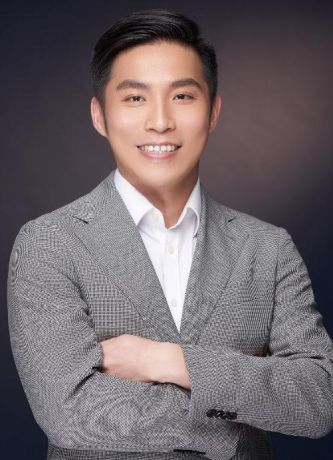
江建緯
江建緯 副教授
現職: 化學系副教授
研究室:超庸館 4F M418室
| 學經歷與榮譽 | |
| 學歷 | 國立台灣師範大學化學系 博士 |
| 行政與學術經歷 |
|
| 研究獎勵 |
|
| 主要研究方向 |
|
研究興趣:
研究內容: 生物藥物因其對人體的兼容性高和副作用較小,在近代醫藥領域逐漸發展為新形態的藥物。所以,通過生物共軛和生物正交化學進行多肽和蛋白質的化學標記和藥物修飾合成,也在其中扮演著重要的促進角色。過去,該領域的進展受到穩定的化學修飾方法不足和生物兼容性較差等阻礙,使其發展較為受限。有鑒於此,我們致力於通過各種新形態的自由基促進化學合成方法,如生物無機模擬酶活化、可見光氧化還原催化和電化學合成反應等,來提高生物分子標記的選擇性和生物兼容性。在確保氨基酸標記選擇性的前提下,我們將繼續朝著經由單電子轉移交叉偶合策略的方向努力,針對各種多肽和蛋白質的進行化學修飾和藥物標記,進而實現簡單、高效且溫和的生物修飾反應。
|

| 年份 | 論文標題與作者 | 期刊資訊 |
| 2026 |
H.-C. Chen, Y.-H. Liu, P.-C. Kuo, C.-H. Chou, K.-W. Jhang, W.-H. Shih, W.-Z. Lee,* C.-J.Su,* and C.-W. Chiang* “Silk-Derived Photoelectrode Enables Sustainable BenzylicEtherification via Photoelectrocatalysis”,
|
ACS Sustain. Chem. Eng., 2026, 14, 2606–2616. |
|
I. Karmakar, X.-W. Huang, H.-T. Hung, R. Bai, C.-Y. Sun, C.-W. Chiang,* and C.-F.Lee* “Electrochemical Sulfinylation-Driven Skeletal Rearrangement of Baylis-Hillman Adducts”, |
Green Chem., 2026, 28, 2109-2122. | |
| 2025 |
C.-Y. Sun, Y.-Y. Chen, H.-C. Chen, H.-L. Li, and C.-W. Chiang* “Photoelectrochemical
Catalyzed Site-selective Tryptophan beta‑Position Functionalization”,
|
J. Am. Chem. Soc., 2025,
147, 38827-38837.
|
|
K.-T. Liu, Y.-L. Hung, K.-W. Jhang, H.-C. Chen, H.-L. Li, and C.-W. Chiang*“Electrochemical/Cobalt Dual Catalysis for Regioselective Tetramerization of Indoles”, |
Asian.J. Org. Chem., 2025, e202400526. | |
| 2024 |
C. Wan, R. Sun, W. Xia, H. Jiang, B.-X. Chen, P.-C. Kuo, W.-R. Zhang, G. Yang, D. Li,* C.-W. Chiang,* and Y. Weng* “Electrochemical Bioconjugation of Tryptophan Residues: A Strategy for Peptide Modification”,
|
Org. Lett., 2024, 26, 5447-5452. |
|
C.-Y. Sun, T.-J. Lin, Y.-Y. Chen, H.-L. Li, and C.-W. Chiang,* “Synergistic Photoredox and Electrochemical Catalysis in Organic Synthesis and Late-Stage Functionalizations”,
|
ChemCatChem, 2024, 16, e202301537. | |
|
江建緯*, 張凱雯, 周芷如, 張宛柔, 陳柏薰, 郭佩錡. “生物共軛與一氧化氮仿生系統:現代醫藥的創新與應用”
|
化學, 2024, 82, 359-373. | |
|
C.-W. Chiang,* Y.-H. Chou, C.-H. Chou, H.-C. Chen, J.-L. Chen, L.-C. Hsu, W.-H.Huang, H.-L. Li, Y.-H. Liu, “Bioinspired Photoredox Oxidation of Alcohols withCopper-containing Galactose Oxidase Analog”,
|
Eur. J. Inorg. Chem. 2024, 27, e202300516. | |
| 2023 |
C.-W. Chiang,* K.-W. Jhang, J.-L. Chen, L.-C. Hsu, W.-H. Huang, H.-C. Chen, T.-J. Lin, C.-Y. Sun, and Y.-N. Li, “Promotion of S-nitrosation of cysteine by a {Co(NO)2}10 complex”, |
Chem. Commun., 2023, D3CC02784H. |
| C.-W. Chiang,* H.-L. Li, T.-J. Lin, H.-C. Chen, Y.-H. Chou, and C.-J. Chou, “Versatile Synthesis of Symmetric and Unsymmetric Imines via Photoelectrochemical Catalysis: Application to N-Terminal Modification of Phenylalanine”, | Chem. Eur. J. 2023, e202301379. | |
| H.-C. Chen, C. Wan, W.-H. Shih, C.-Y. Kao, H. Jiang, Y. Weng,* and C.-W. Chiang,* “Indirect Electrochemical-Induced Trifluoromethylation of Tryptophan Containing Oligopeptides”, | Asian J. Org. Chem., 2023, 12, e202200647. | |
| 2022 |
31. Y. Weng, C.-J. Su, H. Jiang, and C.-W. Chiang,* “Photoredox C-H Functionalization Leads the Site-selective Phenylalanine Bioconjugation“, |
Scientific Reports, 2022, 12, 18994. |
| 2021 | Y. Weng, B. Ding, Y. Liu, C. Song, L.-Y. Chan, and C.-W. Chiang,* “Late-Stage Photoredox C–H Amidation of N-Unprotected Indole Derivatives: Access to N-(Indol-2-yl)amides”, | Org. Lett., 2021, 23, 2710-2714. |
| 2020 | Y. Weng, C. Song, C.-W. Chiang,* and A. Lei*, “Single electron transfer-based peptide/protein bioconjugations driven by biocompatible energy input”, | Commun. Chem., 2020, 3, 171. |
| C. Song, K. Liu, X. Jiang, X. Dong, Y. Weng,* C.-W. Chiang,* and A. Lei*, “Electrooxidation enables selective dehydrogenative [4+2] annulation between indole derivatives”, | Angew. Chem. Int. Ed. 2020, 59, 7193-7197. |